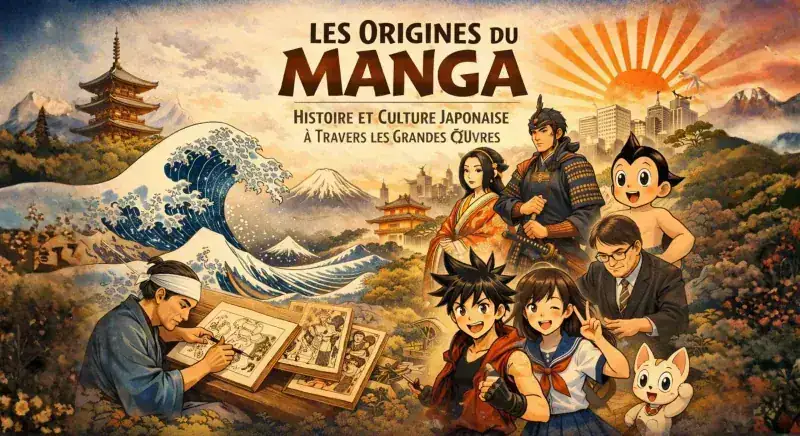
Manga is now read by more than 300 million people worldwide. But where does it really come from? The answer often surprises: the origins of manga go back to 12th-century Japan, long before the invention of modern printing. To understand why samurai, cherry blossoms and spirits still dominate contemporary manga designs, we need to go back to the sources of this unique visual culture.
In this article, you’ll find the complete history of manga’s origins, from the first illustrated scrolls to the great works that defined modern styles. A deep dive into Japanese culture that also explains why manga aesthetics continue to inspire well beyond the drawn panels.
The origins of manga: well before modernity
Contrary to common belief, manga wasn’t born in the 20th century. Its roots plunge into medieval Japanese art, with visual narrative forms that directly prefigure what we read today.
Emakimono: the narrative ancestors of manga (12th century)
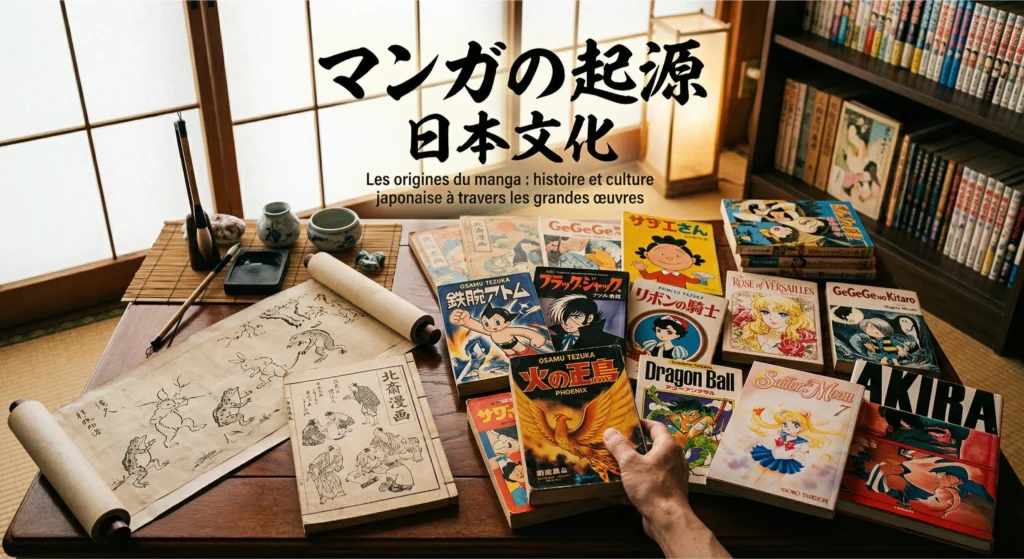
Emakimono are illustrated horizontal scrolls that tell stories in sequential images. The most famous, Chojugiga (literally “humorous animal drawings”), dating from the 12th century, depicts frogs, rabbits and monkeys in comical human poses. Specialists see it as the first example of sequential graphic narration in Japan, with a sense of movement and expression you find directly in modern manga.
What’s remarkable is that these scrolls already use narrative conventions that manga has kept: reading from right to left, decomposition of movement into successive images, and exaggerated facial expressivity to convey emotion.
Ukiyo-e and Hokusai: the birth of the word “manga” (19th century)
The word “manga” itself appears for the first time in 1814, in the work of the famous artist Katsushika Hokusai. He titles his free sketch collections “Hokusai Manga”, a term that literally means “whimsical pictures” or “spontaneous sketches”. These notebooks gather thousands of drawings depicting humans, animals, buildings and scenes from daily life with a freedom of line completely new for the era.
Ukiyo-e, the art of Japanese woodblock prints that reached its peak in the 17th and 18th centuries, profoundly influences manga aesthetics. Clean lines, flat color areas without cast shadow, dynamic compositions and popular subjects (warriors, kabuki actors, courtesans, landscapes) are direct legacies you find in today’s manga.
In short: the origins of manga go back at least to the 12th century with illustrated narrative scrolls, and the word “manga” itself was coined by Hokusai in 1814. Modern manga aesthetics directly inherit from ukiyo-e: clean lines, line dynamism and popular subjects.
The birth of modern manga: the Meiji era and Western influence
Japan’s opening to the West after 1868 marks a decisive turning point in manga history. The country absorbs modern printing techniques and Western comics while reinterpreting them through its own visual culture.
The first illustrated magazines and political cartoons
From the 1870s, illustrated magazines like Japan Punch (founded by British cartoonist Charles Wirgman in 1862) introduce political cartoons in Japan. Japanese artists pick up this format and create their own publications, mixing Western caricature with Japanese sensibility. Jiji Manga magazine, founded in 1902, is one of the first to explicitly use the term “manga” to designate its satirical comics.
Rakuten Kitazawa: the first professional mangaka
Rakuten Kitazawa (1876-1955) is often considered the father of modern manga. He’s the first to professionally use the term “manga” to designate color comics with recurring characters, published in serial form. His character Tagosaku to Mokubei no Tokyo Kenbutsu (1902) is the first manga series in the contemporary sense: a continuous narrative with identifiable characters and structured sequential storytelling.
In short: the birth of modern manga in the strict sense is between 1870 and 1910, at the intersection of Japanese visual tradition and imported Western narrative techniques. Rakuten Kitazawa in 1902 is generally recognized as the founder of professional manga.
Osamu Tezuka: the god of manga revolutionizes everything (1950s-1970s)
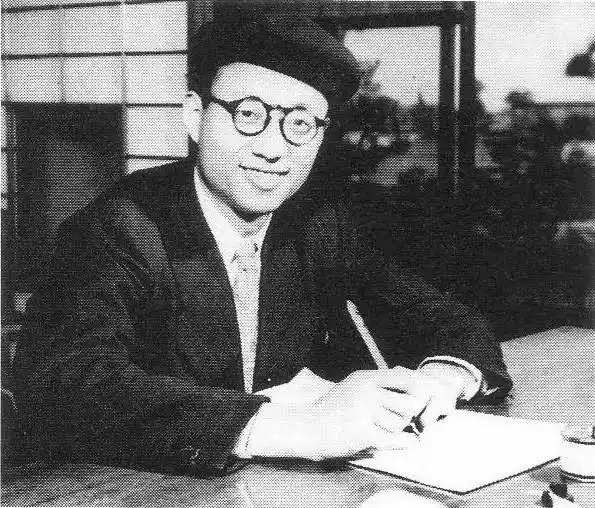
If manga’s origins go back to the Middle Ages, its current face is largely the work of one man. Osamu Tezuka (1928-1989) is universally nicknamed “the god of manga”. What he invents in the 1950s still defines manga’s codes 70 years later.
Cinema’s influence and Tezuka’s narrative innovations
Tezuka is fascinated by cinema, particularly the films of Walt Disney and Max Fleischer. He imports completely unprecedented cinematic techniques into manga: variable camera angles, expressive close-ups, panoramic panels, narrative ellipses and cross-cutting. Before him, manga read like an illustrated book. After him, it lives like a film.
It’s also Tezuka who popularizes the large expressive eyes characteristic of Japanese manga, directly inspired by Disney and Betty Boop characters. These oversized eyes allow conveying complex emotions with economy of line - a graphic solution so effective it became a global standard.
Astro Boy and the birth of the manga-anime industry
In 1952, Tezuka publishes Astro Boy (Tetsuwan Atom), a science-fiction manga featuring an android robot with superhuman powers. Success is immediate and total. In 1963, the series is adapted as a TV cartoon: it’s the birth of anime in the modern sense, and the invention of the manga-anime business model that still structures the entire industry today.
Through his 700 published works and over 150,000 pages drawn during his lifetime, Tezuka also creates the fundamental genres of modern manga: shonen (adventure for boys), shojo (romance for girls), seinen (adult manga) and jidaigeki (historical samurai narratives).
In short: Osamu Tezuka (1928-1989) is the creator of modern manga as we know it today. He imports cinematic techniques into manga, popularizes the large expressive eyes and invents with Astro Boy the manga-anime model that structures the entire contemporary industry.
If samurai universe and feudal Japan fascinate you, discover how these aesthetics directly inspire the BuddyPad manga and anime mouse pad collection, designed for fans of Japanese culture.
The major manga genres and the works that defined them
Manga isn’t a single genre: it’s a medium covering radically different styles and audiences. Understanding these genres means understanding the immense richness of manga culture.
Shonen: the pure energy of adventure
Shonen (literally “young boy”) is the best-selling genre worldwide. It’s characterized by determined protagonists who overcome ever-greater obstacles through willpower, friendship and training. Founding works are Dragon Ball (Akira Toriyama, 1984), One Piece (Eiichiro Oda, 1997), Naruto (Masashi Kishimoto, 1999) and Demon Slayer (Koyoharu Gotouge, 2016). Shonen aesthetics are recognized by explosive action lines, extreme expressions and spectacular fights.
Shojo: intimacy and emotion
Shojo (“young girl”) privileges emotional introspection, interpersonal relationships and complex feelings. Its graphics are distinguished by delicate lines, floral or abstract backgrounds and great attention to subtle facial expressions. Sailor Moon (Naoko Takeuchi, 1991), Fruits Basket (Natsuki Takaya, 1998) and Nana (Ai Yazawa, 2000) are emblematic representatives.
Seinen and jidaigeki: maturity and history
Seinen (“adult man”) addresses a more mature audience with complex narratives, often dark or philosophical. Berserk (Kentaro Miura, 1989), Vinland Saga (Makoto Yukimura, 2005) and Vagabond (Takehiko Inoue, 1998) are flagships. Jidaigeki specifically focuses on historical Japan: samurai, feudal wars, bushido code. These narratives have profoundly influenced the Japanese visual aesthetic you find in contemporary animation and gaming designs.
In short: manga covers very distinct genres. Shonen is the best-selling worldwide thanks to works like Dragon Ball and One Piece. Shojo prioritizes emotion and relationships. Seinen and jidaigeki explore psychological depth and the history of feudal Japan.
Why manga conquered the entire world
Manga’s worldwide success isn’t an accident. It’s explained by a unique combination of cultural, economic and narrative factors that few other media have managed to reproduce.
A medium for all ages and all tastes
Unlike Western comics long associated with childhood or a niche audience, Japanese manga has always offered works for every age group and every interest. Cooking, sports, romance, science-fiction, horror, history, philosophy: there’s a manga for every human passion. This thematic universality is one of the keys to its planetary expansion.
The weekly serial model
Japanese manga is historically published in serial form in weekly magazines (Weekly Shonen Jump, Weekly Shonen Magazine), before being compiled into bound volumes called tankobon. This format creates an intense weekly relationship between reader and work, with cliffhanger chapter endings that maintain addiction for decades. One Piece has been published weekly since 1997 - over 1,100 chapters and more than 500 million volumes sold worldwide.
The 1990s-2000s global explosion
Manga’s globalization massively accelerates in the 1990s with Dragon Ball Z on television, then Pokémon, Sailor Moon and Naruto simultaneously reaching hundreds of millions of children on every continent. The internet then amplifies the phenomenon: scanlations (unofficial translations) circulate from the 2000s, creating a global community of fans long before local publishers catch up.
Today, manga and anime culture has become a global aesthetic reference, well beyond the drawn medium alone. It influences fashion, gaming, music, interior decoration and millions of people’s desk setups around the world. For fans who want to integrate this aesthetic into their daily life, our manga and anime mouse pad collection offers designs inspired by the great aesthetics of Japanese culture, from the samurai universe to cherry blossom landscapes.
In short: manga conquered the world thanks to three main factors. Its ability to cover all genres for all audiences, its weekly serial model that creates intense loyalty, and the 1990s television explosion that exposed Dragon Ball, Pokémon and Sailor Moon to entire generations worldwide.
Manga aesthetics: a universal visual language
What distinguishes manga from all other graphic arts is its own visual language - a set of conventions that allow a reader from any culture to immediately understand what they’re looking at.
The fundamental graphic codes
Manga uses a system of codified visual codes that readers learn intuitively: speed lines for movement, sweat drops for embarrassment, bulging veins for anger, spiral eyes for dizziness. These conventions advantageously replace long textual descriptions and give manga its unique narrative density.
Facial expressivity is pushed to the extreme, with humorous physical deformations (exploding head, mouth taking up the entire face width) for comedic moments, and expressions of surgical precision for dramatic moments. It’s this ability to instantly switch from comedic to tragic that gives manga its unique emotional depth.
Visual aesthetics inherited from Japanese culture
Beyond narrative codes, manga constantly draws from the visual repertoire of traditional Japanese culture. Cherry blossoms (sakura), ravens (karasu), dragons, samurai, koi, torii, shinto spirits (yokai and kami): all these symbols charged with meaning in Japanese culture imbue manga aesthetics and give them a cultural depth that readers worldwide feel, even without knowing their precise origin.
It’s this symbolic richness that explains why manga aesthetics have imposed themselves in so many contemporary creative fields. For fans who want to display this culture in their workspace, an XXL mouse pad with a manga design is one of the most visible and functional ways to integrate this aesthetic into daily life.
In short: manga has a universal codified visual language (speed lines, extreme expressions, shinto symbols) that lets it communicate with any reader regardless of their culture of origin. This language draws from 1,000 years of Japanese visual culture, giving it unique symbolic depth.
Origins of manga: frequently asked questions
When did the first manga appear?
The first forms of Japanese sequential graphic narration (emakimono) go back to the 12th century with the Chojugiga. The word “manga” itself was invented by Hokusai in 1814. But modern manga in the strict sense, with recurring characters and structured narration, was born in the early 20th century with the work of Rakuten Kitazawa (1902).
Who invented manga?
The term “manga” was forged by artist Katsushika Hokusai in 1814. Modern professional manga was founded by Rakuten Kitazawa in the early 20th century. But it’s Osamu Tezuka in the 1950s who defines manga as we know it today, by importing cinematic techniques and creating the major genres (shonen, shojo, seinen).
What’s the difference between manga and anime?
Manga is a printed comics narrative, read from right to left following Japanese convention. Anime is the animated adaptation (cartoon or TV series) of a manga or original work. Most major animes (Dragon Ball, Naruto, Demon Slayer) are manga adaptations. The term “anime” comes from English “animation” phonetized in Japanese.
Why is manga read from right to left?
Manga is read right to left because traditional Japanese writing follows that reading direction, a legacy of writing systems imported from China. When manga structured itself as a medium in Japan, it naturally adopted that reading direction. Western manga editions usually respect this original convention to preserve the author’s narrative intent.
What’s the best-selling manga of all time?
One Piece by Eiichiro Oda is the best-selling manga in history with over 520 million volumes sold worldwide since 1997. It surpasses Dragon Ball (260 million), Naruto (250 million) and Demon Slayer (150 million). These four titles alone represent a considerable share of the global manga market estimated at over 4 billion dollars annually.
A thousand-year-old culture that never stops evolving
The origins of manga remind us that this medium wasn’t born from nothing: it’s the heir to over 1,000 years of Japanese visual narration, from the medieval Chojugiga to Hokusai’s prints, through Tezuka’s narrative revolution. This historical depth explains why manga aesthetics continue to so powerfully influence global visual culture.
Today, this culture expresses itself far beyond drawn pages. It permeates video games, fashion, interior architecture and the workspaces of fans worldwide. Showing your belonging to this culture means claiming a thousand-year-old visual heritage, a symbolic richness few other artistic traditions can match.
For fans looking for an original gift around manga culture or simply wanting to extend this aesthetic to their daily desk, the BuddyPad manga and anime mouse pad collection offers designs inspired by the great aesthetics of Japanese culture: samurai, cherry blossoms, cosmic universes and many more. Available in Standard, Large and XXL deskmat formats.