You’ve just invested in a new gaming or office mouse, and you’re wondering which surface to use it on to get the most out of it? The mouse pad surface, glide and accuracy comparison is a question every user eventually asks, whether competitive gamer or remote-work professional. Cloth, hard, hybrid: each material offers radically different behavior, and the wrong choice can degrade your performance or daily comfort. At BuddyPad, we’ve tested and curated dozens of references to understand exactly what distinguishes these three big surface families. In this guide, we’ll break down the concrete differences in glide, accuracy, durability and use so you can choose with confidence.
Cloth surface: comfort, control and versatility
How a cloth surface behaves
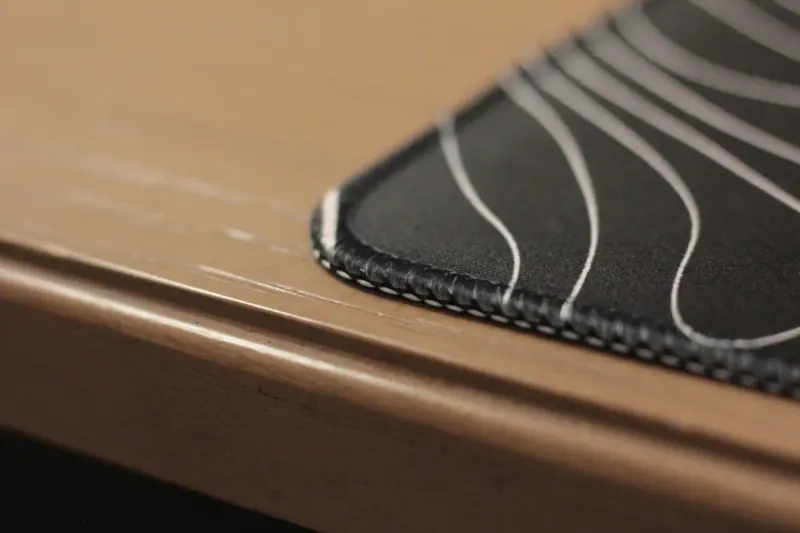
The cloth pad remains the most-used reference in the world, and for good reasons. Its fibrous surface generates moderate friction that lets your mouse decelerate progressively, encouraging excellent control on precise movements. Concretely, a standard cloth pad offers a friction coefficient between 0.3 and 0.6, depending on weave density and fiber quality.
Speed or control: depending on the cloth chosen
There are actually two important sub-categories:
- “Speed” cloths: tight weave, almost smooth to the touch, fast glide ideal for competitive FPS like CS2 or Valorant
- “Control” cloths: looser weave, increased friction, perfect for strategy games or precision work
- Standard polyester cloths: balanced compromise for mixed gaming and office use
A well-maintained cloth pad keeps its glide properties up to 18-24 months of intensive use.
At BuddyPad, we’ve found that over 65% of our customers opt for a cloth surface as a first choice, often for its softness on the wrist and silent operation. To explore all the nuances between these materials, check our article on differences between pad materials which deepens the cloth versus hard comparison in detail.
Hard surface: maximum speed and longevity
Characteristics of a hard surface
Hard mouse pads - also called hard pads - are made from ABS plastic, anodized aluminum or tempered glass. They offer extremely fluid glide with very little resistance, making them particularly prized in esports disciplines where reaction speed is paramount.
Accuracy and skate wear
On a hard surface, accuracy mainly depends on the quality of your mouse skates. A new skate on aluminum allows ultra-fast micro-corrections, with virtually zero perceived latency. Conversely, worn skates glide irregularly and reduce accuracy. Major plus: a hard pad doesn’t warp, doesn’t fray and cleans in seconds.
The downsides not to overlook:
- More audible glide noise than cloth
- Wrist discomfort on long sessions
- Often higher price for premium aluminum or glass models
If you work from home full time, the material question takes on another dimension. Our dedicated comparison on surfaces for professional work will help you choose between cloth, PU faux-leather and hard in a remote-work context.
Hybrid surface: the best of both worlds?
What a hybrid pad really offers
Hybrid pads combine a textile base with a stiffened back or surface treatment. Result: glide faster than classic cloth, with consistency close to a hard pad, but keeping a discreet usage noise and some softness on contact.
Who is it really suited for?
The hybrid pad particularly suits the following profiles:
- Versatile gamers who alternate between fast FPS and precision-demanding RTS
- Creatives - graphic designers, video editors - for whom glide consistency matters as much as comfort
- Heavy office users who want a durable surface without sacrificing ergonomics
At BuddyPad, we’ve noted a 40% increase in hybrid pad sales over the last 12 months, a sign of growing demand for versatile solutions. Note that aging can be less predictable than pure cloth: the treated surface can degrade in zones under heat or sweat.
To miss no selection criteria before your purchase, find all the advice on how to choose the best mouse pad in 2026 in our complete guide.

Frequently asked questions
Which surface offers the best accuracy for competitive gaming?
For aim-focused competitive play, a "speed" cloth pad or an aluminum hard pad offer the best accuracy, because their homogeneous surface guarantees consistent glide without snags. The final choice depends on your play style and mouse sensitivity.
Does a hard pad wear out mouse skates faster?
Yes, hard surfaces wear skates faster than soft cloth, especially on raw aluminum or glass. We recommend checking your skates' condition every 3-6 months if you use a hard pad intensively.
Is the hybrid pad compatible with all types of optical sensors?
In the vast majority of cases, yes: modern optical sensors like the PixArt 3395 or 3370 work perfectly on a hybrid surface. Just check the surface is contrasted enough for the sensor to read it correctly.
Conclusion
Cloth for control and comfort, hard for speed and durability, hybrid for versatility: there’s no universal surface, only the one that fits your use, your mouse and your style. Take the time to evaluate your priorities before choosing. Find all our recommendations and complete selection on BuddyPad, and if you want to go further, explore our blog for other practical guides on optimizing your setup. Find the ideal pad for your desk today!